
 please note that the following page is in progress!
 As the year draws to an end, fog moves in from the pacific to lay on the ridges of the mountains near me as a mink does on a woman's neck. Lets take a look at the Slipni 2025 year!
Film
2025 was definitely marked primarily by movies. I remember it pretty well: on january 24th -slightly on a whim - my good friend dana proposed a plan: she would watch 500 movies in 500 days, as to match gregg turkington's mythical feat several years prior. I think equally on a whim I said that I would tag along for the journey - managing to track all of it on letterboxd. Very quickly letterboxd became one of my most used sites in 2025.
in 2025 I watched 404 things, with 102 of them being short films, the rest being feature length productions. I tried watching short films either to supplement a shorter movie, or on days when I didnt have the energy to watch a whole movie. I tried taking larks into different eras and regions of cinema, but I always felt like I never really settled into any movement with a satisfactory length. Lets take a look at some different movements of film -
Mainstream Classics
There were a number of very popular films that fell into my blindspot that I watched this year. While some of them were positive suprises ( The Matrix, 12 angry men, the devil wears prada, the wizard of Oz, and amelie for instance) The vast majority of these popular films were very poor, and sometimes upsetting to watch. I think in the new year, Ill try to avoid watching popular things that I know wouldnt appeal to me.
Pre and Post Studio System
I watched a good ammount of Chaplin's filmography, ultimately ending in his very excellent Limelight. I loved the work of Alice-Guy Blache, and found out that Zora Neale Hurston had contributed a series of extremely intresting ethnographic recordings of black american southerners from a practically unknown period. Entering the studio period, the scope and artistic constraints rose to the surface. I found works from the 20's (although unfortunate in their vaundeville tendencies) to have a gritter and freer form, although the technical and artistic innovations of the 30s from Modern Times to The Wizard of Oz really knocked my socks off!
Next year id like to watch through keaton's work, and step into both chinese and japanese early cinema too. I saw The Goddess by Yonggang Wu, and Mr Thank you by Hiroshi Shimizu - whose more darker and socially aware filmaking contrasted heavily with their american counterparts.
Iranian New Wave
At the start of the year I made a goal to watch some iranian new wave films. I stuck mostly with Kanoon films, the early work of Kiarostami and Panahi, before watching Rasoulof's seed of the sacred fig (the only miss from iran so far), Panahi's wonderful Offsides and settling with Rankin's Universal language. I definitely missed out on Kiarostami's post Kanoon stuff, as well as huge names from iran such as Makmalbaf. I hope to see much more in the future.
I'm out here to bomb, period. That's what I started for. I didn't start writing to go to Paris. I didn't start writing to do canvases. I started writing to bomb. To destroy all lines. That's what I'm doing. [How long do you think you'll do it?] Till I'm finished.
Now that you've heard that, do you understand what I'm saying to you when I say that I don't understand him? He's out there to bomb, destroy all lines. What have the lines ever done to him? What have the lines ever done to him?
At the dawn of the seventies, a single phrase began to appear hundreds of times across new york, painted on buildings trains and streets it read: TAKI183. People were confused, it wasnt a municipal code like USA (Underground Service Announcement), it served seemingly no purpose at all. The youth figured it out first: it was a name. Taki, short for the greek Demitrius and 183 for 183rd street, his neighborhood. Taki started by painting his name on ice cream trucks at first, something he picked up from another early graphiti artist. But after getting a job as a delveryman, TAKI183s became citywide. Once people understood it to be a name, the graphiti boom began and to city officials, trains have never been clean since.
At the same time, New York had entered a period of inequality and recession that threatened to kill the city outright. Fires burnt down 80 percent of the south bronx, other neighborhoods were similarly affected. The majority of these were arson, found to be started by landlords hoping for an insurance payout. As the New York Times reported in 1977, "When the economy is improving, fires diminish in number and severity. When the economy turns down, fires increase." One will notice that the residents of these neighborhoods were overwhelmingly black, puerto rican and poor. Media coverage at the time blamed the residents of the area, but why would someone burn down their own home?
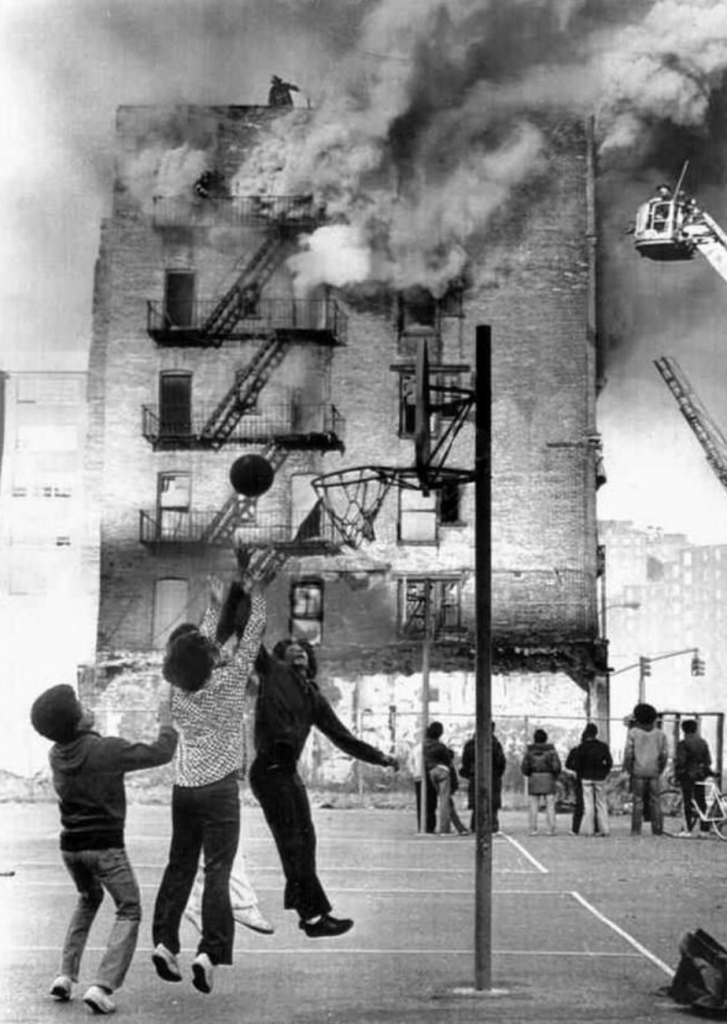
Paul Hosefros, 1975
Stevenson, G. (1977, September 11). Point of view.
After budget cuts in 1975 promised to lay off 11,000 officers, the policeman's union handed out "fear city" flyers to tourists at the airport and times square, promising a spree of criminal activity, violence, the end of everything, etc. President Gerald Ford vetod a proposed bailout of the city, condeming the city to massive debt. Although essential services were to be maintained "White House officials said privately, however, that Ford had no intention of committing federal money to maintain such services. They also conceded that as defined by the Ford administration, “essential services” may not include public schooling."
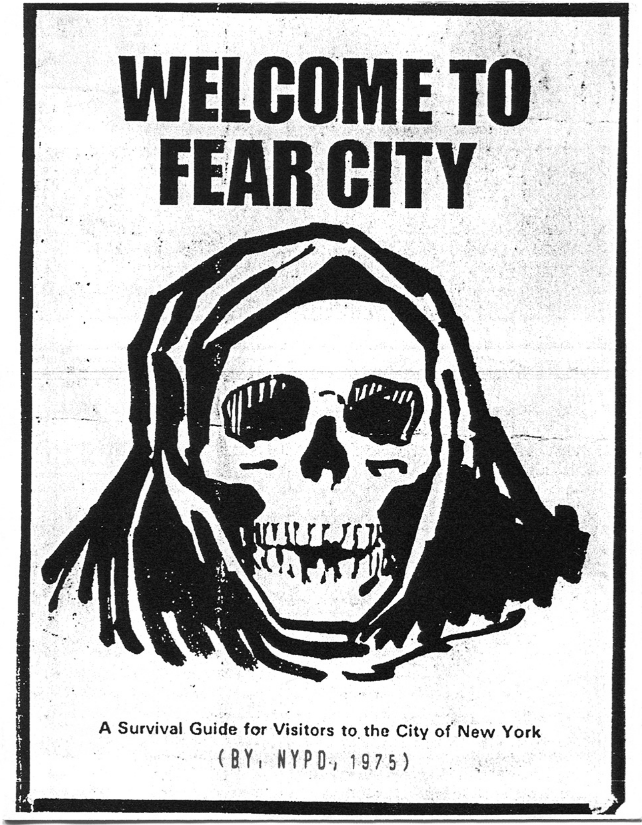
NYPD, 1975
While New York was broke at the time, but cuts to policing budget in the city can also be seen as a response to the corruption scandal of 1970, 5 years prior. After reports of systematic corruption spread on the New York Times, whistleblower Frank Serpico was shot while conducting a police raid, he attests that he was "left to bleed out", as his fellow officers did not enter the apartment with him, nor did they call for an ambulance. A neighbor in the appartment complex called for emergency services instead. Yale's police union handed the similar pamphlets out in 2023, during contract negotiations. Riper, F. V. (1975, October 30). Ford to city: Drop dead in 1975.
The seventies proved disasterous for the youth of New York, who found themselves at the forefront of the detransition away from the manufacturing economy of the fifties and sixties. Starting from an unemployment rate of arround 10 percent in 1969 (close to the national average at the time), unemployment rates rose year by year until 1983: a period where less than one third of youth could find employment. The nature of work itself had changed too - youth were increasingly herded into retail oriented positions, which marked a change from the office and manufacturing positions of the sixties. As the workforce skilled upwards, with more complex systems and greator technical skills needed, more and more teenagers were left out of the economy. The new workplace was that of retail and fast food, which were staffed by entirely teen workforces with extremely high turnover rates. "Walk into a McDonald's, a sueprmarket on a sunday afternoon, or a department store some weekday evening: what you see is a workforce dominated by youth, with the exception of a handful of adult managerial personel... employed teenagers find themselves isolated from adults. Thus, working youth lack contacts with skilled and more mature workers who could provide a source of social control, as well as an example which youth might model their behavior." Retail and fast food workplaces are reliant on the high turnover of their staff in order to keep salaries low, and prevent unions from forming, thus the use of teen workers was key to their ability to provide cheap goods at thin margins.
Waldinger, R., & Bailey, T. (1985). The Youth Employment Problem in the World City.With work oppurtunities drying out and a world increasingly unfriendly to the poor youth of new york, one can trace the birth of an alternative language : one shaped by the youth reified in it's rejection of the powers that be. New music in the form of hiphop, new dances and new slang. hiphop's continuous rejection of authority has incesnsed critics for decades: when you see someone out to graphiti all train lines, you ask "What have the lines ever done to him?", without understanding that the lines are the world and it is moving on without you.
as Taki himself puts it:Since there are no more student deferments, maybe I'll go to a psychiatrist and tell him I'm TAKI 183. I'm sure that will be enough to get me a psychological deferment.”
We often complain of a lack of literacy in the youth - reports of how the young can barely spell, much less express a mastery of the great classics are commonly relayed. These arguments usually derive themselves from the discourse explored by Aronowitz and Girroux, Aronowitz and Girroux argue agiasnt a "Canon" in education, ultimately finding that value of education is in the personaly utility of knowledge, creating a multiplicity of values which cannot be captured by a canon. When you find a "classic of literature" you must ask: what is a classic? and to whom? regardless of whether the proponents of these ideas know it or not. It is in this way the idea gains a life of its own, coopting will and intent to propagate itself as a discourse sometimes independent of it's proponents. More than an institutional failure that has depirved a student of nessecary skills, it seems more indicitive that a general social alienation is most apparent in the young, as they show the products of their development more clearly than others. There is a refusal to commit any mention of the reduction in social fabric as a result of a diminishing intra class solidarity - stemming from an increase in labor demands, effects of multigenerational suburbanization, crime wave scares, smaller familial sizes, it should be mentioned that smaller familial sizes are a result of a confluence of many interconnected factors, which often influence each other. a reduction in familial sizes is par for the course in the way that cultures industrialize, as labor demands have perhaps the largest impact of the sizes of families - see South Korea. and other factors of western alienation- all diminish our capacity of existing within a greator social life. Children ironically -due to enrollment in social programs- have more communal engagement at the behest of their parents, than most parents do. it is perhaps not entirely true that it takes a village to raise a child, but it is no suprise that the child is not spared when the village is burned. The diminishment of these external factors away from the discourse of the "youth literacy crisis" is this way illiterate - unable to read the forest when looking at it's trees.
citations
Aronowitz, Stanley, and Henry A. Giroux. 1991. Postmodern Education : Politics, Culture, and Social Criticism. Minneapolis: University of Minnesota Press.
Borges, J.L. and E. Weinberger. 2000. Selected non-fictions. New York: Penguin Books.